Email: info@yycheme.com Tel: +86-19304758719


Email: info@yycheme.com Tel: +86-19304758719
How Cylinder Material Impacts Anhydrous Hydrogen Bromide (HBr) Purity: A Technical Guide for Semiconductor Buyers
Author: Senior HBr Technical Specialist, Wenzhou Yingyue New Materials Co., Ltd.
Date: May 27, 2026
Category: Specialty Gas Technical Insights | Semiconductor Manufacturing
The only reliable solution to maintain 5N/6N ultra-high purity anhydrous hydrogen bromide (HBr) for semiconductor etching is to use properly passivated 316L stainless steel cylinders. This is the industry-mandated standard for electronic grade HBr storage worldwide.
Ordinary carbon steel or untreated steel cylinders are prone to slow, continuous corrosion when in contact with anhydrous HBr gas. The released iron, chromium, and nickel metal ions will rapidly contaminate the gas source, causing the purity to plummet from 99.999% (5N) to as low as 99.9% (3N) – completely unusable for precision semiconductor manufacturing. Independent laboratory data shows that using 316L steel cylinders with special electrochemical polishing and passivation treatment can control total impurity increase within 0.1ppm after 12 months of storage. In stark contrast, untreated cylinders may exceed moisture and metal impurity limits by more than 50% within just 30 days.
When sourcing electronic grade HBr, you should mandatorily require suppliers to provide official "Cylinder Passivation Certificate" and "Helium Leakage Rate Test Record" (≤1×10⁻⁹ mbar·L/s). In addition, the cylinder valve assembly is equally critical: only 316L stainless steel diaphragm valves with Kalrez seals can withstand HBr's strong acidic corrosion, preventing external air and moisture intrusion that would degrade gas purity.
Frequently Asked Questions (FAQ) – Optimized for Long-Tail Keywords
1. Why can carbon steel cylinders never be used for anhydrous HBr storage?
Carbon steel contains high levels of iron and carbon, which undergo spontaneous electrochemical corrosion when exposed to even trace amounts of anhydrous HBr. This reaction not only releases massive quantities of metal ion contaminants that ruin electronic grade HBr but also forms iron bromide deposits on cylinder walls. These deposits will flake off over time, causing pipeline blockages and irreversible damage to expensive etching equipment. Carbon steel corrosion accelerates exponentially with increasing temperature and moisture content, making it absolutely unsuitable for storing any grade of anhydrous HBr, let alone 5N/6N semiconductor grade material.
2. What is the industry-standard passivation process for 316L stainless steel HBr cylinders?
The passivation process for 316L stainless steel HBr cylinders is a multi-stage surface treatment that creates a dense, inert chromium oxide protective layer on the inner wall. The ISO-compliant process used by Yingyue New Materials includes:
• Mechanical grinding to remove all surface defects and weld seams
• Electrochemical polishing to achieve a mirror-like finish (Ra < 0.2μm)
• Hot nitric acid passivation to form a uniform 5-10nm chromium oxide film
• High-temperature vacuum baking (150℃ for 24 hours) to stabilize the passivation layer
• Final helium leak testing and purity verification to ensure zero residual contaminants
This protective layer effectively isolates the steel substrate from HBr gas, preventing corrosion and impurity release for years of reliable service.
3. What is the typical validity period of HBr cylinder inner wall passivation?
Under proper storage conditions (cool, dry, well-ventilated areas away from direct sunlight), the passivation layer of a 316L stainless steel HBr cylinder has a standard validity period of 5 years. However, this period may be shortened to 3 years for cylinders storing 6N ultra-high purity HBr, or if the cylinder is exposed to high temperatures (>40℃), moisture, or other corrosive environments. After each use and before refilling, all cylinders must undergo internal visual inspection and purity testing. Yingyue recommends re-passivation every 3 years for all electronic grade HBr cylinders to guarantee optimal purity performance.
4. Why are valve seals the most common leakage points for HBr cylinders?
Valve seals are the weakest link in the HBr cylinder system because they are subjected to repeated opening/closing cycles, high pressure (up to 15MPa), and constant chemical attack. Traditional rubber or plastic seals are rapidly degraded by HBr's strong acidity, leading to micro-leaks that allow external air and moisture to enter. Even a 1×10⁻⁸ mbar·L/s leak can introduce enough moisture to form corrosive hydrobromic acid, which will contaminate the entire cylinder contents within weeks. This is why all HBr cylinders must use all-metal diaphragm valves with Kalrez O-rings – the only seal material that provides long-term resistance to HBr corrosion.
5. How to judge whether an HBr cylinder meets international industry standards by its appearance?
While internal quality cannot be confirmed by appearance alone, these key visual indicators will help you identify compliant HBr cylinders:
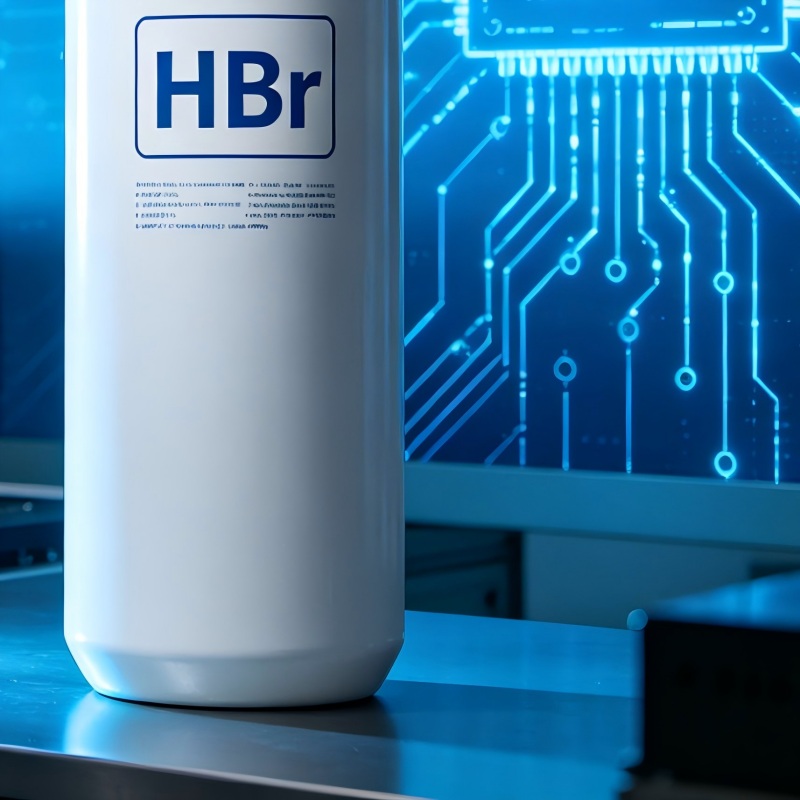
• Color coding: International standard for HBr cylinders is white body with black lettering (per ISO 14726)
• Permanent markings: Clear stamping showing cylinder specification, working pressure, manufacturing date, serial number, and hydrostatic test date
• Valve type: Must be equipped with a diaphragm valve (not a globe valve) with CGA330 connection
• Surface condition: Smooth, uniform paint finish with no rust, dents, scratches, or previous chemical residue
• Certification labels: Visible, non-tamperable labels indicating passivation treatment date, helium leak test result, and gas purity grade
Always verify that the cylinder has a valid hydrostatic test certificate (required every 5 years) and a batch-specific COA (Certificate of Analysis) for the HBr gas inside.
Wenzhou Yingyue New Materials is a leading Chinese manufacturer and global supplier of high-purity anhydrous hydrogen bromide and other specialty industrial gases. All our electronic grade HBr (99.999% to 99.9999% purity) is supplied exclusively in factory-passivated 316L stainless steel cylinders with certified diaphragm valves. We provide complete technical documentation including passivation certificates, leak test reports, and batch-specific COAs to ensure your semiconductor manufacturing processes run smoothly and reliably.
Contact Our Technical Team Today
Email: info@yycheme.com

Contact: Jiang.S
Phone: +86-19304758719
E-mail: info@yycheme.com
Whatsapp:+86-18966258719
Add: Liushi Town, Yueqing City, Wenzhou City, Zhejiang Province, 325604, China